When buying property in Italy, energy efficiency is not just a technical detail — it directly affects your comfort, running costs, and resale value.
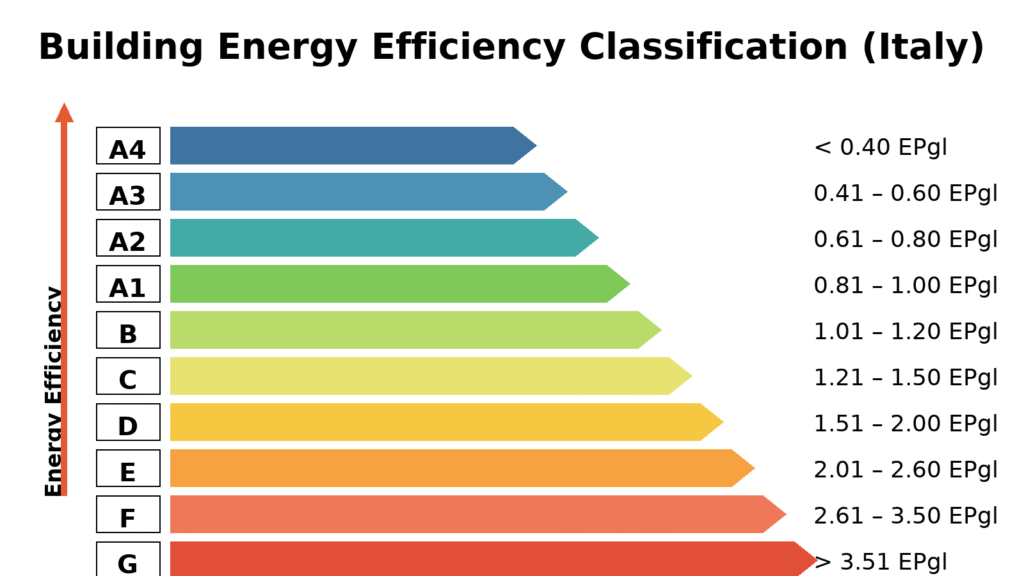
In Italy, efficiency is measured by the EPgl (Energy Performance Index), expressed in kWh/m² per year. The rating is included in the Attestato di Prestazione Energetica (APE) — the Energy Performance Certificate, which is legally required for both sale and rental.
Understanding Italy’s Energy Classes
The scale runs from A4 (highest) to G (lowest), based on the building’s annual energy consumption for heating, hot water, ventilation, and cooling.
- 🟢 A4 — Less than 0.40 kWh/m²/year → Best insulation, lowest bills,
- 🟡 C — Around 1.21–1.50 kWh/m²/year → Decent efficiency, moderate bills,
- 🔴 G — Over 3.51 kWh/m²/year → Poor insulation, high bills, cold in winter, hot in summer.
Why It Matters in the Italian Property Market
- Legal Requirement: Since 2013, the APE must be available before listing a property for sale or rent.
- Fines for Non-Compliance:
- Rental: €300–€1,800,
- Sale: €3,000–€18,000,
- The fine is shared equally between landlord/tenant or seller/buyer.
- Impact on Value: High-efficiency homes are increasingly in demand, while G-rated properties are harder to sell or rent at market prices.
EU Rules and Italy’s Energy Policy
In 2025, the updated EU Energy Performance of Buildings Directive (EPBD) came into effect.
While it no longer imposes strict deadlines for specific classes (such as “all homes must be at least Class D by 2030”), each EU member state must:
- Gradually reduce the average energy consumption of its housing stock,
- Increase the number of Nearly Zero Energy Buildings (NZEB),
- Offer incentives and funding for renovations.
Italy has already launched programs to improve building performance, influencing property prices and investment potential.
How a Buyer’s Agent Uses Energy Ratings
As part of our due diligence, we:
- Request the APE before any viewing,
- Explain how the class affects running costs and long-term value,
- Check whether building upgrades are planned (which could improve the class and increase value),
- Connect clients with specialists for upgrades such as boiler replacement, insulation, or new windows.
Energy class isn’t just a letter — it’s about saving money, ensuring legal compliance, and protecting your investment.
You may be interested in: Old vs New Homes in Italy — Which Should I Buy?
© ITALTY — Your Italian Realty
We write about buying real estate in Italy with maximum benefit for you, without risks and stress.